






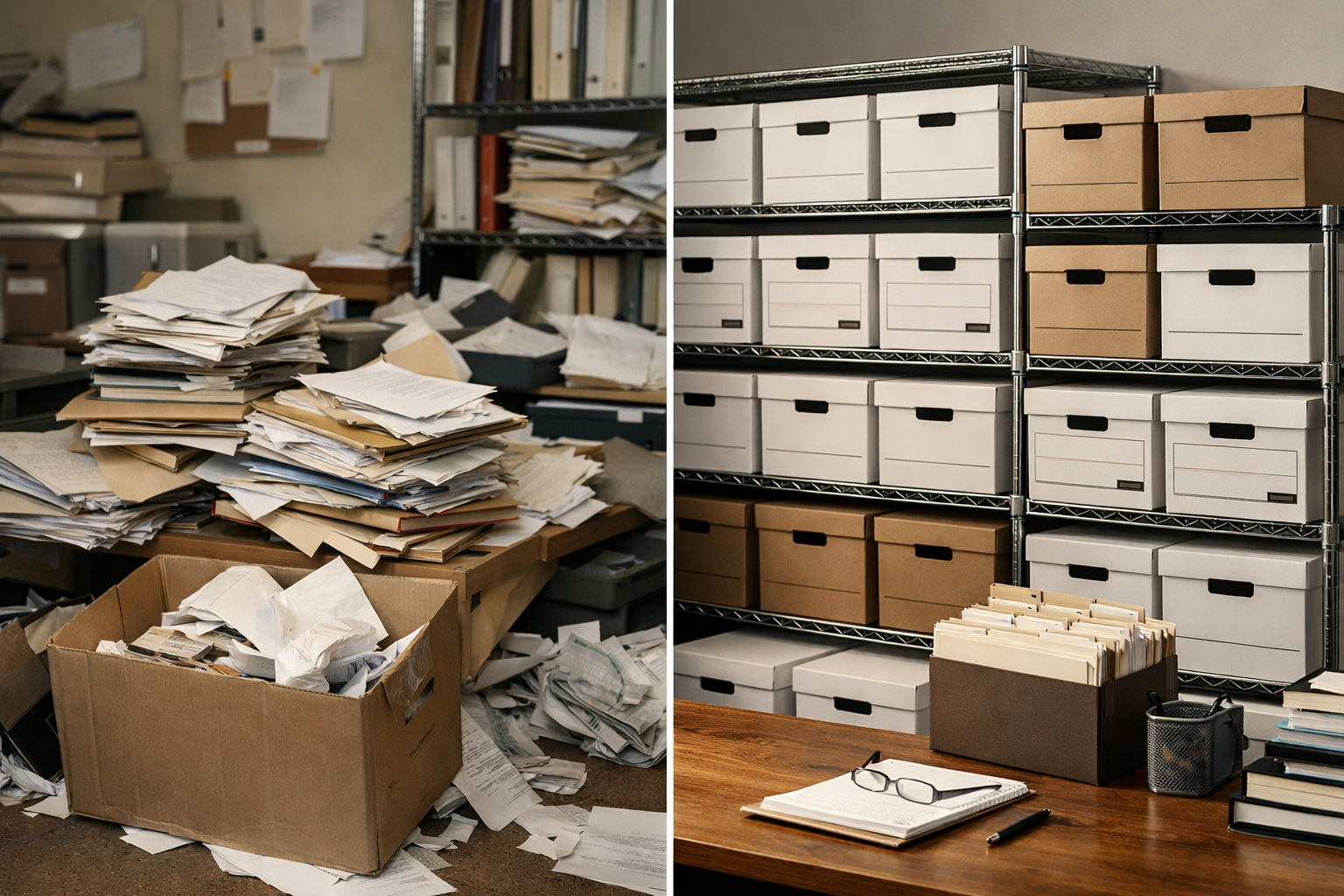
Key Takeaways
- Match file storage boxes to how records are actually used, not just what costs less upfront—archived tax files need different box strength and access than active invoices or legal folders.
- Check fit first: choosing file storage boxes for letter or legal documents, plus support for hanging folders and rails, is one of the fastest ways to avoid returns and wasted shelf space.
- Buy low-minimum batches of file storage boxes when cash flow and storage space are tight; ordering 25 to 100 units often keeps offices stocked without piling up dead inventory.
- Compare materials with purpose—cardboard file boxes work well for annual archive storage, while plastic storage boxes with locking lids make more sense for shared offices and frequent document access.
- Reduce cabinet overflow by using stackable file storage boxes with clear labels, dividers, and handles; that setup often cuts retrieval time faster than cramming one more drawer or lateral cabinet.
- Measure total cost, not shelf price alone, because the wrong file storage boxes can lead to crushed boxes, damaged folders, replacement orders, and hours lost hunting for records.
Small offices are paying retail prices for a records problem they already know is growing. That’s why file storage boxes have stopped being a throwaway office-supply purchase and started looking like a smarter inventory decision—especially for teams trying to manage invoices, employee records, tax files, and legal paper without tying up cash in oversized orders.
In practice, the shift is easy to spot. Office managers aren’t just asking whether a box holds letter or legal file folders anymore; they’re checking lid strength, hanging rails, stacking limits, handles, and whether the box will survive six months in a stockroom without sagging. Small business owners are doing the same math from a different angle. Buy too few, and they’re stuck reordering at the worst possible time. Buy too many, and those flat packs eat shelf space while money sits in cardboard.
And that’s exactly why low-minimum buying is getting more attention. A plain filing box now has to do more than hold paper—it has to protect records, fit the office setup, and keep storage costs from creeping up one small purchase at a time.
File storage boxes are shifting from office supply staple to budget-smart buying decision
File storage boxes now sit squarely in the cost-control conversation.
- Low minimums cut waste. Small offices don’t need a pallet of cartons sitting flat in a back room next to old cabinets and a jammed cabinet drawer. Buying only 25 to 50 units keeps cash free for payroll, toner, and the boring stuff that actually hurts when it runs short.
- Right-size buying lowers hidden spend. Teams sorting invoices, tax files, and legal folders can match box counts to real records volume instead of guessing. That matters more now, because paper isn’t gone—it has just shifted into compliance files, HR backups, signed contracts, and year-end filing.
- Better organization reduces replacement orders. Good document storage boxes support hanging folders, dividers, rails, and both letter and legal formats, so records don’t slump, tear, or get reboxed six months later.
Why low-minimum purchasing matters more for small offices right now
Simple math. If an office manager overorders 200 office file storage boxes at even $3 to $5 each, that’s $600 to $1,000 tied up — and usually parked beside metal shelves, wooden furniture, or rolling drawers that were already full.
How file storage boxes help control supply costs without overordering
In practice, record storage boxes work best when offices standardize two sizes: one for archives and one for active filing. That keeps labels cleaner, stacking safer, and retrieval faster (especially during audit season).
Where rising records volume is changing the way offices buy storage
More firms now split retention by purpose, using letter size file boxes for daily paper flow and larger boxes for closed-year files. That’s a smarter buy than stuffing folders into lateral cabinets until the lock sticks and nobody can find the keys.
What buyers actually want when they search for file storage boxes
Think of this search the way a smart friend would over coffee: people typing in file storage boxes usually aren’t browsing for ideas. They’re ready to compare. They want sizes that fit real folders, materials that won’t cave in after six months, and price tiers that make sense whether they need 12 boxes or 120. In practice, that means buyers often scan office file storage boxes by cost per box, stack strength, and whether the lid stays flat under a full cabinet cleanout.
Transactional intent: ready to compare sizes, materials, and price tiers
Most searches come from office managers and small-business owners replacing old cabinets, clearing a drawer wall, or moving invoices out of crowded lateral files. They compare three things fast:
- Material: cardboard, plastic, or heavier board
- Capacity: letter or legal filing loads
- Price breaks: small packs versus bulk sale cartons
That’s why document storage boxes and record storage boxes get cross-shopped with locking bins, hanging folders support, and replacement lids.
The must-have features buyers check first—lid, handles, lock, and hanging folders support
Bluntly, buyers check function before color.
A good lid matters. So do cutout handles that won’t tear, rails for Pendaflex or other hanging folders, — sometimes a lock if payroll, legal, or tax files are involved. If a box looks nice but can’t carry loaded folders—pass.
And that’s where most mistakes happen.
Letter vs legal file storage boxes: the fit issue that causes the most returns
Here’s what most people miss: returns happen because the inside dimensions don’t match the folders. Letter size file boxes work for standard office paper; legal files need extra length, not guesswork. Buyers should measure the folder, not the paper, before ordering. That one step saves money. Fast.
Which file storage boxes work best for records, invoices, and legal documents
Most offices buy the wrong box first.
The mistake usually shows up six months later, when invoices slump, legal files bend, and a stockroom shelf starts looking more like a junk drawer than a filing system. The smarter move is to match file storage boxes to access frequency, paper weight, and whether staff use hanging folders or flat stacks.
Cardboard file storage boxes for archive rooms and annual record retention
For year-end archives, document storage boxes made from corrugated cardboard still work best because they stack well, label easily, and cost less per file than wood or metal cabinets. In practice, cardboard boxes fit annual tax files, paid invoices, and closed client folders that don’t need weekly handling.
Plastic file storage boxes with locking lids for active document access
For active paperwork, plastic beats cardboard—especially in shared offices where lids get opened all day. Good office file storage boxes should have locking tops, molded handles, and enough depth for letter or legal folders without crushing tabs.
Portable file boxes with rails for hanging folders in small offices and home workspaces
Small offices need mobility. Portable letter size file boxes with rails for Pendaflex or other hanging folders help keep current contracts, unpaid bills, and employee forms within reach, not buried in drawer cabinets or rolling furniture.
Heavy-duty file storage boxes for bulk paper, banker records, and long-term filing
For bulk retention, choose double-wall or reinforced record storage boxes rated for dense paper loads—banker records can get heavy fast. A practical shortlist:
Let that sink in for a moment.
- Archive use: cardboard with lids and dividers
- Daily access: plastic with locking clips
- Tight spaces: portable boxes with rails
- Heavy loads: reinforced boxes for legal and filing sets
How to choose file storage boxes by office setup, not just by price
Is the cheapest box really the smart buy? Usually not. In practice, the right file storage boxes depend on where they’ll sit, who will touch them, and how often someone needs a file fast.
For cabinet overflow: replacing crowded drawer and lateral cabinet space with stackable boxes
When a filing cabinet or lateral cabinet is jammed, stackable document storage boxes can pull inactive files out of prime drawer space without creating a mess. The honest answer is simple: use boxes for closed-year invoices, legal records, and flat archive folders, then keep only active Pendaflex sets in cabinets.
A practical rule works well:
- Daily-use files: cabinet drawers
- Monthly-reference files: nearby office file storage boxes
- Archive files: stacked record storage boxes
For shared offices: using labeled boxes, dividers, and folders to cut retrieval time
Shared space changes everything. In one office with four staff members, clear labels, color-coded folders, and dividers can cut retrieval time from 3 minutes to under 45 seconds—which matters when people keep interrupting each other to find one missing file.
And that’s exactly why office file storage boxes should include front-facing labels, hanging rails, and enough width for both letter and legal filing. A locking lid helps for HR papers or client records—small feature, big difference.
For home and small business use: balancing appearance, portability, and storage capacity
Home offices need boxes that don’t look like warehouse leftovers. Portable letter size file boxes work best when they’re easy to lift, hold 12 to 15 pounds comfortably, and still fit shelves, wood furniture, or closet storage without wasted space.
Think about what that means for your situation.
Looks matter—but capacity matters more. For small teams, the best file storage boxes balance clean appearance, quick access, and enough room for replacement folders, keys, dividers, and year-end records.
The numbers are pushing more buyers toward low-minimum file storage boxes
An office manager clears out a packed cabinet, counts six years of invoices, then checks retail marketplace pricing for replacements. The one-off units look cheap at first. By checkout, the math turns ugly.
That shift is why more buyers are moving to file storage boxes in low minimums instead of grabbing random singles. In practice, ordering 25 to 100 units usually cuts the per-box cost by 20% to 40%—and it avoids the mix-and-match problem that comes with used, plastic, or flat retail options that don’t stack cleanly on shelves or fit hanging folders well.
Why ordering 25 to 100 boxes often beats buying one-off units from retail marketplaces
Smaller batch wholesale orders hit a sweet spot. Buyers get consistent sizing for letter size file boxes and legal records, but they don’t get buried in pallet-level inventory.
- Lower unit cost: 25 boxes often price far better than five retail units
- Better fit: standard rails support hanging folders without sagging
- Less mismatch: one spec works across cabinets, drawer systems, and shelves
Storage space, cash flow, and reorder timing—the three pressures behind smaller batch buying
Cash is tighter, back rooms are fuller, and nobody wants dead stock. That’s why office file storage boxes and document storage boxes ordered in measured batches make more sense—they leave room for seasonal records and keep reorder timing under control.
The data backs this up, again and again.
What most offices miss about total cost: damaged records, wasted filler, and dead shelf space
The honest answer is that cheap boxes often cost more. Weak walls, bad lids, and oversized footprints lead to crushed record storage boxes, wasted filler, and shelf gaps that eat up valuable storage. One packaging supplier, Ucanpack, has pointed to the same pattern: buyers focus on unit price first—then pay later in replacement files, extra handling, and lost space.
How smart buyers compare file storage boxes before placing an order
Here’s the surprise: in small offices, buying the cheapest file storage boxes often costs 20% to 30% more within a year once crushed lids, bad stacking, — wrong-size reorders show up. The smarter move isn’t flashy. It’s a simple comparison process that matches box strength to record volume, filing habits, and shelf space.
Material checklist: cardboard, plastic, wood-look, and metal-style options
For most paper archives, document storage boxes made from corrugated cardboard still make the most sense because they ship flat, store easily, and work well with hanging folders. Plastic works better where moisture is a risk, while wood-look and metal-style options fit front-office use where cabinets or open shelves are visible (and appearance matters).
Strength checklist: stacking, flat shipment, lid fit, and replacement needs
- Stacking: Check weight limits before piling boxes three high.
- Flat shipment: Saves space, but weak folds can fail fast.
- Lid fit: A loose top invites dust and bent legal papers.
- Replacement: Standard sizes make repeat orders easier—important for record storage boxes bought every quarter.
Practical buying checklist for filing boxes with hanging folders, locks, keys, or rolling access
Buyers comparing office file storage boxes should confirm rails for Pendaflex or other hanging folders, whether a lock actually comes with keys, and if rolling access is worth the added cost. Not every file room needs locking boxes. HR and legal usually do.
A final framework for choosing file storage boxes that match record volume and budget
A practical rule works well: use letter size file boxes for active invoices and drawer overflow, legal-width boxes for contracts, and heavier-duty cartons for archive stacks. One supplier executive at Ucanpack has noted that buyers who standardize two or three sizes usually cut waste, filler, and replacement orders. That’s the part most teams miss.
Most people skip this part. They shouldn’t.
Frequently Asked Questions
What size file storage boxes should a business buy for office records?
Start with what the files actually are: letter or legal. Most file storage boxes are made for one or the other, and trying to force legal paperwork into a letter box creates bent edges, jammed hanging folders, and wasted space. For mixed records, buying two clearly labeled box sizes works better than trying to make one box do everything.
Are file storage boxes better than a filing cabinet?
For active, daily-use records, a filing cabinet or lateral cabinet is still easier. For archive files, closed invoices, tax records, and older client folders, file storage boxes usually cost less and take up less floor space. In practice, most small offices need both: cabinets for current work, boxes for retention.
Can file storage boxes hold hanging folders?
Yes, but only if the box is built with rails or reinforced edges sized for hanging folders. A cheap box without support will sag fast—especially once you load it with full Pendaflex folders and dense paper files. Check whether the box is made for letter or legal hanging files before ordering.
What material is best for file storage boxes: cardboard, plastic, wood, or metal?
Cardboard boxes are the practical pick for long-term archives because they stack well and cost less. Plastic file storage boxes are better for damp areas or frequent handling, while metal and wooden options make more sense in executive offices where appearance matters as much as function. Honest answer: most back-office records don’t need vintage wood or decorative furniture styling—they need a box that won’t split when lifted.
Most guides gloss over this. Don’t.
Should file storage boxes have lids, locks, or keys?
A lid matters. Dust, light exposure, and accidental spills ruin paper faster than people expect. A locking file box with a lock and keys is worth it for HR files, legal paperwork, and anything with bank details, but routine archived folders usually don’t need that extra cost.
How many files fit in a standard file storage box?
A standard file storage box for letter or legal records often holds 1,500 to 2,500 sheets, depending on whether you’re using plain folders, hanging folders, or thick dividers. That’s a wide range because invoices and contracts don’t stack like empty paper. If the box feels tight on day one, it’s already overpacked.
Can file storage boxes be stacked safely?
Yes, if they’re rated for stacking and packed evenly. Heavy boxes on the bottom, lighter boxes on top, and never build a leaning tower beside a desk or in a stockroom aisle. Flat lids help; crushed corners don’t.
Are portable or rolling file storage boxes worth buying?
Sometimes. A rolling file box or portable holder with handles makes sense for office managers who move records between a drawer, front desk, and archive area, or for firms that carry files to meetings. But for static storage, wheels just add cost and usually cut into capacity.
What features matter most when choosing file storage boxes for a small office?
Look for five things: the right size for letter or legal files, support for hanging folders, strong handles, a secure lid, and clear labeling space. If the office keeps records for years, add moisture resistance and reinforced corners to the list. Color choices like black, gray, or even yellow are fine, — they shouldn’t distract from basic function.
The short version: it matters a lot.
Should old files stay in cabinets, drawers, or move into file storage boxes?
Move them. Keeping closed records in active cabinets and drawers is one of the fastest ways to clog up an office and make current filing harder than it needs to be. File storage boxes free up working space, and they make yearly cleanouts far less painful.
What’s changed is simple: office storage is no longer a set-it-and-forget-it supply purchase. For small businesses and busy office managers, file storage boxes now sit at the intersection of cash flow, space limits, and records control. Buying too few creates clutter and last-minute scrambling. Buying too many ties up money and fills shelves with empty inventory. The smarter move is tighter sizing, lower minimums, and a clearer match between box type and document use—archive retention, daily access, or portable filing.
That shift also explains why buyers are looking past price alone. A cheap box that bows under stack weight, won’t fit legal files, or needs replacing in six months isn’t cheaper. It’s just a delayed expense. The better buying decision comes from checking the details first: letter or legal fit, lid security, handle strength, and whether hanging folders actually sit correctly inside.
For any team reviewing file storage boxes this quarter, the next step is practical: count current record volume, separate active files from archive files, and build a box list by use case before placing the order. That’s how offices spend less, find documents faster, and stop paying for storage mistakes twice.
For more great reading, visit our site and explore related topics.